I started getting heartburn as a kid. My mom, also a chronic heartburn-sufferer, had me take Tums. It was what she did. Her bathroom cabinet was like Costco for Tums. We had an inexhaustible supply.
Her father had also suffered from unshakable heartburn. I remember we’d visit him in Oklahoma City and he’d be constantly popping Tums or Rolaids. He couldn’t drink milk, but he doused himself in coffee and chain-smoked unfiltered cigarettes. It didn’t seem odd to me that stomach never felt right. When he died, it was a stomach infection that killed him.
I started taking Tums when I was a kid, maybe 12 or 13 years old. Three or four a day, just to moderate the discomfort. There was no mistaking what I had for anything other than heartburn. The sensation fit the name perfectly. It would come in waves, wherein something not unlike a gentle belch would escape from my stomach into my esophagus, and it would push a burning sensation up toward my throat as it did. When it was really bad, I could taste it in the back of my throat. I couldn’t connect it with any particular food or activity, but I could show you exactly where I felt it. Draw a line on my chest, starting directly below my sternum and continue up to the sternal head. That’s Heartburn Alley.
I was a skinny kid, tended to my diet, exercised daily, and slept well. With the exception of eating more hot salsa than the average American kid probably ate, I wasn’t doing any of the typical things to fuel heartburn’s fire in my body, but it was relentless nevertheless. There were good days and bad days, and there were always Tums. Lots and lots of Tums. And it went on like this until three years ago.
In 2009, I experienced what I thought might be a heart attack. Lots of pressure in my chest, shortness of breath, dizziness, and ever-escalating fear. I went to the ER, and spent two days in the hospital being tested and treated for, apparently, nothing. The attending physician concluded I had suffered a GERD attack of some sort, and ordered me to start taking a proton pump inhibitor and see my doctor for follow-up examination. I complied, but her diagnosis didn’t make any sense to me. If anyone knew what acid reflux felt like, it was me, and what I’d experienced before going to the ER was not reflux.
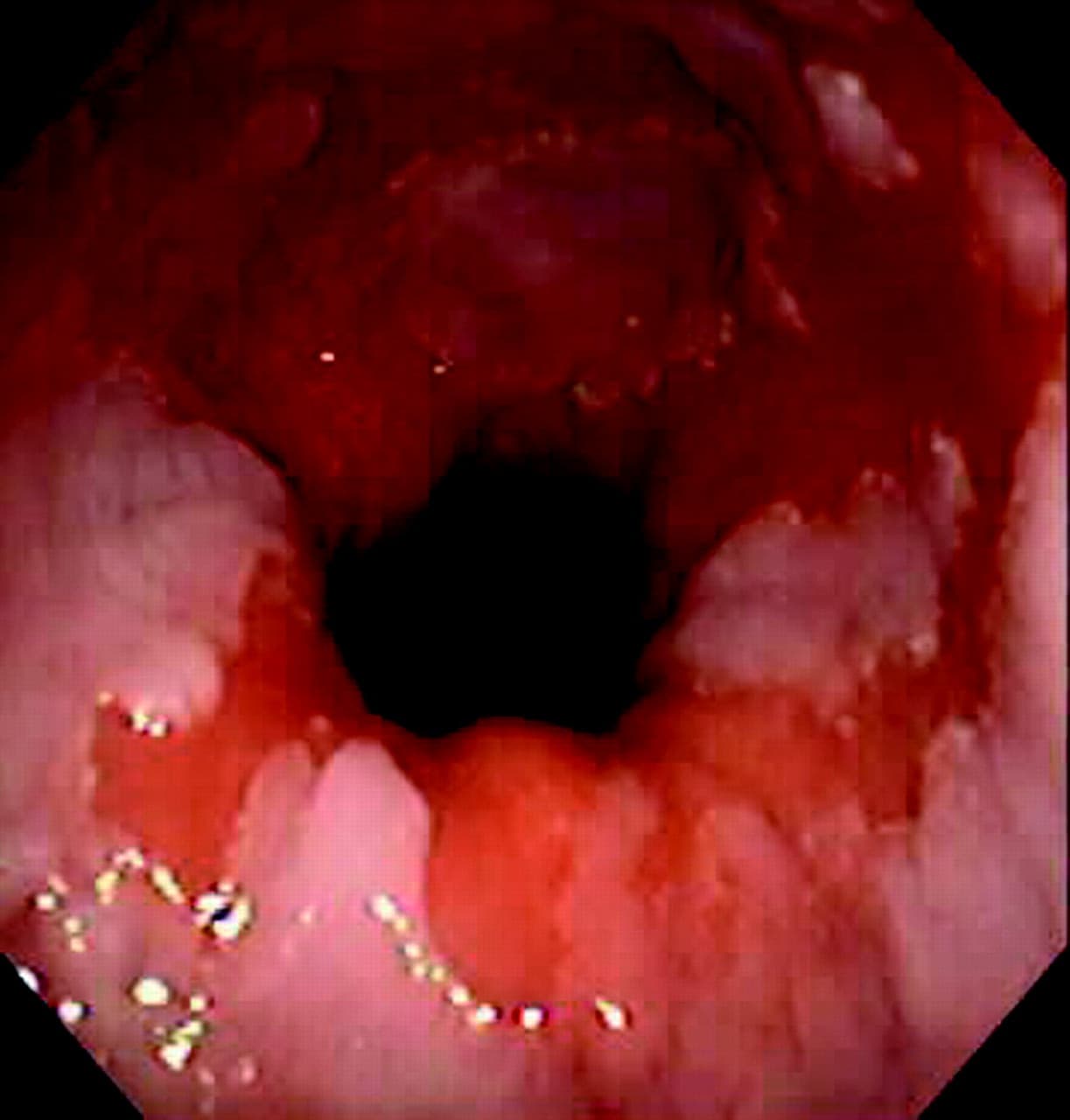
Over the following month or so, I saw my PCP and a GI specialist, and was scoped to check for a pre-cancerous condition called Barrett’s Esophagus (pictured above) that can result from prolonged chronic reflux. The scope procedure was revelatory: While I didn’t have Barrett’s, I did have visible scarring all up and down my esophagus. More importantly, the scope revealed that I am missing a critical piece of anatomy at the junction of my stomach and esophagus. Fully equipped, humans have a sphincter and a little flap there, the purpose of which is to regulate the passage of matter in and out of the stomach. Me, though? No flap. My years of reflux had almost completely dissolved it and I had, in turn, become ever-more susceptible to reflux. Huge bummer to discover, but one that will probably end up having saved me from dying in my 40’s of esophageal cancer.
Practically speaking, some things have had to change since this discovery. For one, I cut back on offending (acidic) foods. I used to drink four or five cups of coffee per day, now I drink one or two. I used to drink red wine several times a week, now I almost never do. Also on my avoid-most-of-the-time list: really spicy foods, orange juice, tomato sauce, vinegar, really greasy foods, and whatever seems to aggravate the heartburn. Additionally, I take a drug called Protonix every day. I had to try numerous similar drugs (all proton pump inhibitors) to find the right one, and even this one is not without its drawbacks. Chief among those is that, in slowing the production of stomach acid, it puts a heavier burden on my intestines than before, and you can imagine how that strain manifests itself.
Finally, even with this relatively effective treatment regimen in place, I still get occasional bouts of painful heartburn. If it comes at night, I’ll sometimes wake up with a mouthful of stomach acid, thinking I’m throwing up, and have to run to the bathroom. Those nights, I take a chewable Pepcid Complete and sleep sitting up until the episode passes (generally 2-3 hours).
It’s clear that I’m doing a better job of treating this condition now than prior to my 2009 endoscopy discovery. Before that, I never knew heartburn was anything to be concerned about. But what sent me to the ER that year remains, in my mind, unknown. The closest I can get to understanding it is that I had a panic attack. Maybe there was a lot going on at work. I don’t remember anymore. But when I read about a friend’s struggle to understand how or if non-cardiac chest pains indicate a diagnosis of GERD, man do I understand where she’s coming from. They might! They might not! Who knows!
If you don’t already have heartburn, that type of diagnostic uncertainty is enough to make sure you get it.